The mushrooms must not become overheated or crushed and should remain separated by species where possible.
Classification, trade and inspection
Wild mushrooms are not ordinary market goods: classification, documentation, separation and traceability together protect both buyer and seller.
Regulatory focus: This page is a study map for understanding Hungarian rules. For actual trade, always follow the current law and the instructions of the authority and market operator.
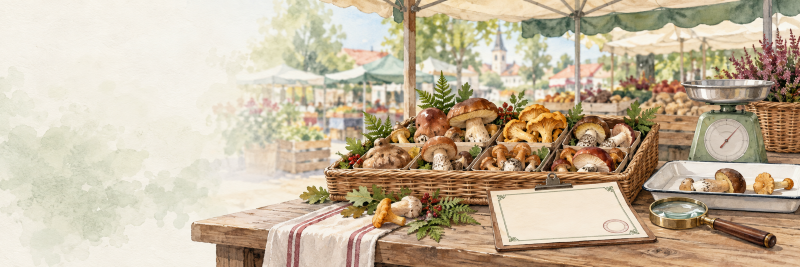
Food safety
From forest to market: a checked route
Expert classification is not merely a label: species identification, condition assessment, documentation and responsible sale all come together in it.
1. The checked route in four steps
Keep this order in mind from collection to sale at the market.
A qualified expert examines the fresh batch intended for sale by species and condition.
The classification certificate and any use conditions are tied to the batch.
Species and mushrooms must be sold separately from other foods, with the certificate visibly displayed.
2. What does classification decide?
An expert does more than name a species: the state of the batch and whether it can be separated also matter.
May be placed on the market
A species suitable for human consumption, correctly identified and fresh, can receive a classification certificate.
Unsuitable or protected
Poisonous, unsuitable or protected mushrooms must be removed and separated from the batch.
Inseparable mixing
If poisonous mushrooms cannot be clearly separated, or a batch contains death cap, the batch is unsuitable for human consumption.
3. Certificate, display and traceability
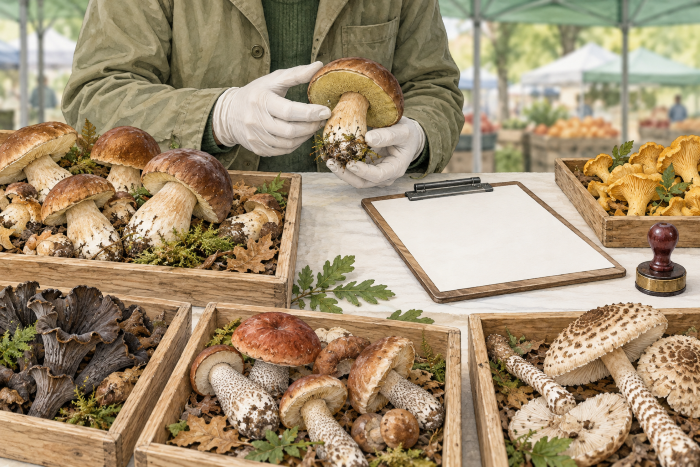
The document is not a formality
- A mushroom classification certificate is issued by species for mushrooms suitable for human consumption and intended for sale.
- At market sale, the certificate must be displayed clearly beside the batch; it is valid only at that place and on that day.
- Product-accompanying documents also carry the certificate number and required use condition.
- Documents must be retained; the exact retention period depends on the operator and form of sale.
4. Market safety from two viewpoints
Seller / food business operator
- Keeps species separate and apart from other foods.
- Displays only fresh, classified batches and visibly places the required certificate.
- Also follows the use conditions assigned to the species.
Buyer
- Buys wild mushrooms only at a designated, permitted selling place.
- Checks the certificate and chooses sound, fresh specimens.
- Does not buy mushrooms from door-to-door sellers or unverified sources.
If you picked a protected mushroom
Collecting protected mushroom species is prohibited and they cannot be classified for human consumption, so do not eat, give away or take them to market. If identification is uncertain or one entered the collection accidentally, do not further mix it with edible mushrooms: leave the complete batch unchanged and show it to an expert. Do not attempt to “replant” an already picked specimen on your own; an expert or nature-conservation authority can advise on the next step.
5. If illness or suspicion arises
The food business operator isolates suspect mushrooms, batches, mushroom remains, food remains and cleaning waste; suspends processing, use and sale of related food; and promptly notifies the competent district office.
This learning module does not replace official notification or current professional guidance.
Sources: the 107/2011. (XI. 10.) VM regulation and NÉBIH guidance. Laws and local market requirements can change; always verify current conditions before taking concrete action.

 I have loved mushrooms since childhood, and I have also been a programmer for a long time. Combining these two hobbies, I wrote this website. Previously, I had two other mushroom identification sites, which I sold. Only one of them remains accessible today. My goal with the current site is to create an easy-to-use search and identification platform that works great both in the field and at home. I hope it brings joy to others.