
 I have loved mushrooms since childhood, and I have also been a programmer for a long time. Combining these two hobbies, I wrote this website. Previously, I had two other mushroom identification sites, which I sold. Only one of them remains accessible today. My goal with the current site is to create an easy-to-use search and identification platform that works great both in the field and at home. I hope it brings joy to others.
Bartha László
Species flashcards
Practice area: created for the 303-species Hungarian mushroom inspector requirement. It is not an official examination; requirements in other countries may differ.

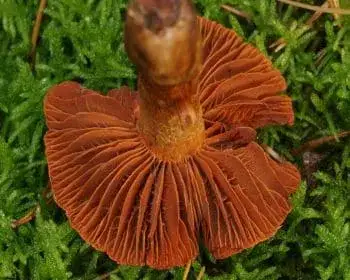
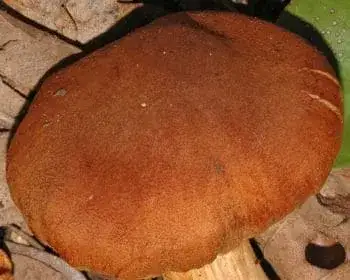
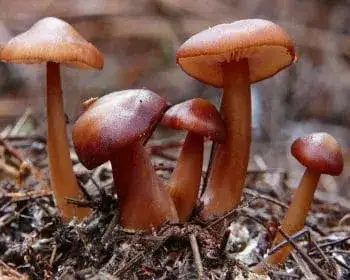
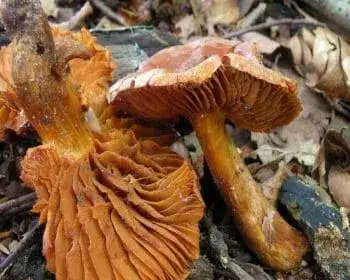
Deadly Webcap
Cortinarius orellanus
poisonous
- Habitat: deciduous
- Fruiting season: June – October
- Cap: hemispherical umbonate scaly wrinkled velvety wavy
- Stem: cylindrical tapering
- Fertile layer: curved adnate sparse thick convex
Description
Cap: Convex or flat, thin-fleshed, 3-7 cm in diameter. Color brown, yellowish-brown, reddish-brown, orange-brown, covered with fine, fibrous scales, later bare. Not sticky. Remnants of the cobweb-like veil are sometimes visible on the cap margin.
Gills: Initially pale brownish-yellow, finally rust-colored. Spores yellow, almond-shaped, granular.
Stem: Slender, thin, rigid, straight, 3-8 cm long, 3-10 mm thick. Yellow-, brownish-yellow, rust-brownish, lighter in color than the cap.
Flesh: Firm, tough, leathery, brownish or rust-brownish. Smell and taste:
Spore: Rusty, reddish-brown, 9-12.5 x 6.5-8.5μm. spherical, rough surface.
Occurrence: On forest soils, primarily in mountain coniferous forests, in summer and autumn, abundant in many places. Here, it has only appeared in certain locations.
Edibility: Poisonous. Prolonged, continuous consumption causes severe, possibly fatal poisoning, not classifiable into the usual poisoning types. Similar toxins have been detected in closely related species in northern countries.
Confusion: Does not resemble our edible mushrooms. Its darker color and habitat distinguish it well from the fairy ring champignon. Many other webcaps and some mock mushrooms resemble it, but none of them are edible.
Note: The Latin name Cortinarius refers to the partial veil that protects the gills on the young mushroom; cortina means curtain. In most species belonging to the Cortinarius genus, the partial veil connects the stem to the cap margin in the form of fine radial threads, unlike other membranous partial veils.
Species description: The great Swedish mycologist Elias Magnus Fries described and named the species Cortinarius orellanus in 1838.
Taxonomy
- PhylumBasidiomycota
- ClassAgaricomycetes
- OrderAgaricales
- FamilyCortinariaceae
- GenusCortinarius
- Species: orellanus
- Described by: Fr.
- Hungarian name: mérges pókhálósgomba
- Lifestyle: mycorrhizal
- Edibility: poisonous
