
 I have loved mushrooms since childhood, and I have also been a programmer for a long time. Combining these two hobbies, I wrote this website. Previously, I had two other mushroom identification sites, which I sold. Only one of them remains accessible today. My goal with the current site is to create an easy-to-use search and identification platform that works great both in the field and at home. I hope it brings joy to others.
Bartha László
Species flashcards
Practice area: created for the 303-species Hungarian mushroom inspector requirement. It is not an official examination; requirements in other countries may differ.

Wood Pinkgill
Entoloma rhodopolium
poisonous
- Habitat: deciduous
- Fruiting season: June – November
- Cap: umbonate smooth wavy
- Stem: cylindrical tapering
- Fertile layer: adnate sparse smooth
Description
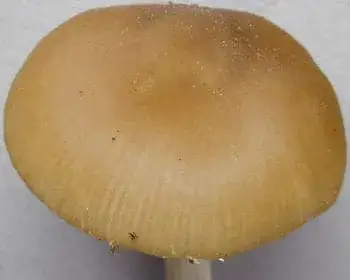
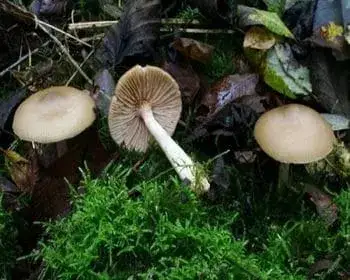
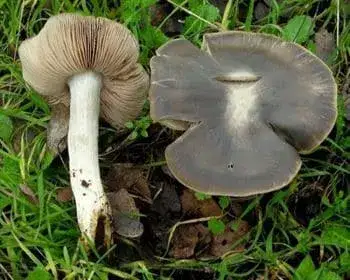
Cap: 5-10 cm in diameter; convex, then flattening, often bluntly umbonate, finally becoming slightly depressed, with wavy margin; gray, grayish-yellow, light olive-gray, whitish-gray in dry weather; surface bare, silky shiny.
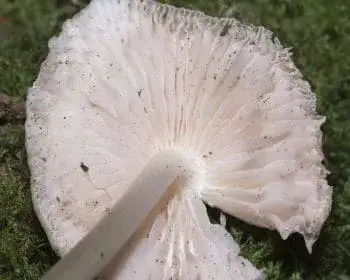
Gills: Slightly adnate to the stem, wide; white when young, then pinkish, finally pinkish-flesh-colored; their edge more or less cracked.
Stem: 5-12 cm long, 1-1.5 cm thick; cylindrical or tapering downwards; whitish; surface longitudinally fibrous, silky shiny, slightly powdery at the apex.
Flesh: Very thin in the cap, fibrous in the stem; whitish; odorless or weakly alkaline smell; astringent taste.
Spore: Pink; 8-10.5 x 7-8μm; rounded-angled.
Occurrence: From June to November, in deciduous forests, common species.
Edibility: Mildly poisonous, causes gastrointestinal problems.
Confusion: Similar to the poisonous livid pinkgill and the edible brown shield, clustered domecap and the spring pinkgill.
Note: rhodopolium comes from the prefix rhodo - red or reddish (Greek for rose), and the word polium - stem. Referring to the color of the gills and the stem. Entoloma comes from the ancient Greek words entos - inner, and loma - edge.
Species description: In 1818, the great Swedish mycologist Elias Magnus Fries described it and gave it the scientific name Agaricus rhodopolius. In 1871, the German mycologist Paul Kummer transferred this species to the entholoma genus, so its scientific name became Entoloma rhodopolium.
Taxonomy
- PhylumBasidiomycota
- ClassAgaricomycetes
- OrderAgaricales
- FamilyEntolomataceae
- GenusEntoloma
- Species: rhodopolium
- Described by: (Fr.) P. Kumm.
- Hungarian name: zöldesszürke döggomba
- Lifestyle: soil saprotroph, mycorrhizal(?)
- Edibility: poisonous
