
 I have loved mushrooms since childhood, and I have also been a programmer for a long time. Combining these two hobbies, I wrote this website. Previously, I had two other mushroom identification sites, which I sold. Only one of them remains accessible today. My goal with the current site is to create an easy-to-use search and identification platform that works great both in the field and at home. I hope it brings joy to others.
Bartha László
Species flashcards
Practice area: created for the 303-species Hungarian mushroom inspector requirement. It is not an official examination; requirements in other countries may differ.

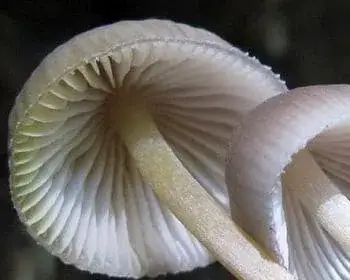
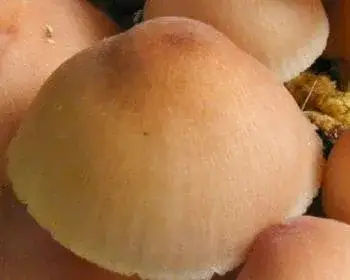
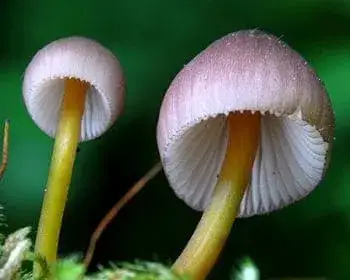

Renate's Mycena
Mycena renati
not edible
- Habitat: deciduous stump
- Fruiting season: May – November
- Cap: conical umbonate bell smooth grooved
- Stem: cylindrical tapering hollow
- Fertile layer: adnate decurrent tooth sparse smooth
Description
Cap: 1-2.5 cm in diameter. Initially the cap shape is conical, then egg or bell-shaped, finally becoming convex, with a small umbo in the center. Its margin is grooved. Initially yellowish-brown, ochre, brownish edged, later pinkish-brown, finally fading to cream-colored and only the center remains pinkish-brownish. Its surface is bare.
Gills: Decurrent on the stem with small teeth, wide, white when young, becoming pinkish-tinged with age.
Stem: 4-5 cm long, 0.2-0.5 cm thick; cylindrical, tapering downwards, clustered; hollow; golden yellow; surface smooth, shiny, fluffy, fibrous at the base.
Flesh: Very thin, soft, watery; whitish, nitrogenous smell, no characteristic taste.
Spore: White; 6.5-10 x 5-7 µm; elliptical, smooth, with oil droplets.
Occurrence: From May to November, in deciduous forests, mainly beech forests, on rotting wood, not rare species in Hungary.
Edibility: Not edible.
Confusion: There are several similar, inedible bonnet mushrooms.
Note: The specific name epipterygia reminds of epi - meaning on and pterugion - (small) wing. The mushroom has many names and references. The most common synonyms: mycena flavipes, mycena renati, mycena epipterygia. renati means rebirth. falvipes means yellow foot.
Species description: In 1772, the Italian mycologist Giovanni Antonio Scopoli first described this mushroom, naming it Agaricus epipterygius. One of the currently accepted scientific names is Mycena epipterygia from 1821, when the British mycologist Samuel Frederick Gray (1766-1828) placed it in the Mycena genus. The French mycologist Lucien Quélet described it under the name mycena renati in 1886. In 2005, Giovanni Robich provided the description of var. alba.
Taxonomy
- PhylumBasidiomycota
- ClassAgaricomycetes
- OrderAgaricales
- FamilyMycenaceae
- GenusMycena
- Species: renati
- Described by: Quél.
- Hungarian name: sárgástönkű kígyógomba
- Lifestyle: wood saprotroph
- Edibility: not edible
