
 I have loved mushrooms since childhood, and I have also been a programmer for a long time. Combining these two hobbies, I wrote this website. Previously, I had two other mushroom identification sites, which I sold. Only one of them remains accessible today. My goal with the current site is to create an easy-to-use search and identification platform that works great both in the field and at home. I hope it brings joy to others.
Bartha László
Species flashcards
Practice area: created for the 303-species Hungarian mushroom inspector requirement. It is not an official examination; requirements in other countries may differ.
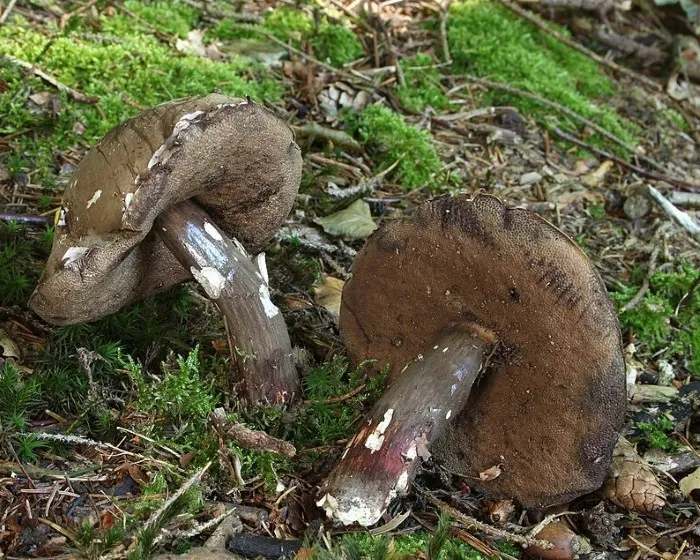
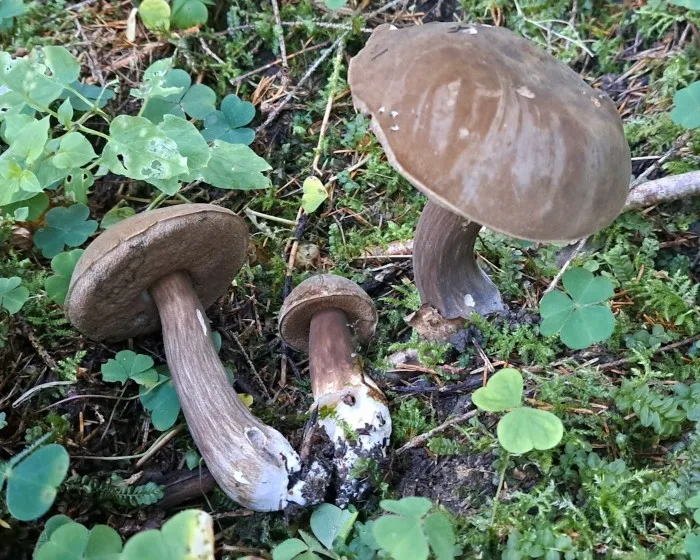
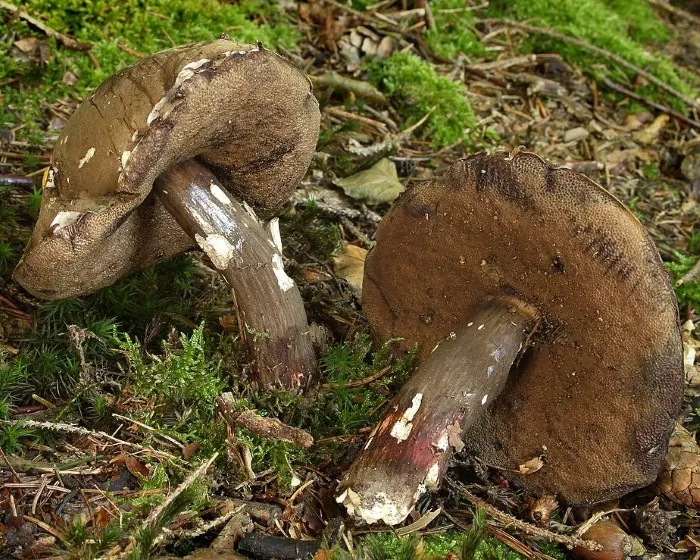
Dusky bolete
Porphyrellus porphyrosporus
poisonous
Protected · 10 000 Ft
- Habitat: deciduous coniferous
- Fruiting season: June – October
- Cap: hemispherical spreading infolded felty dry matte
- Stem: cylindrical ventricose bulbous granular
- Fertile layer: thick adnate curved narrow
Description
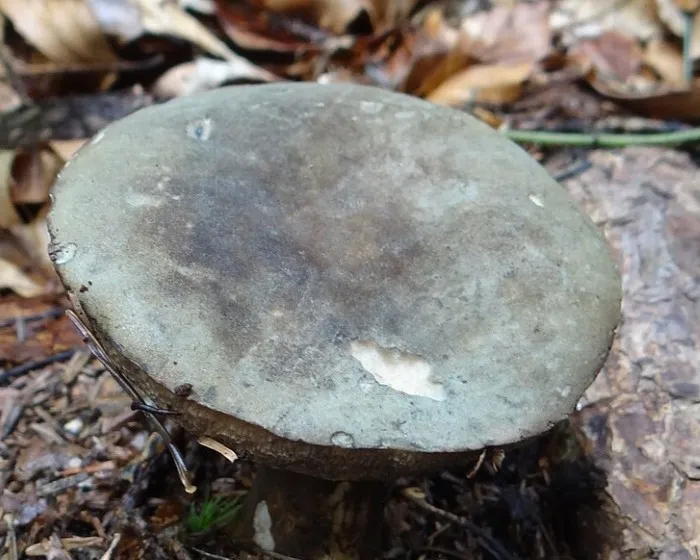
Cap: 5–15 cm across, hemispherical when young, later convex to spreading. The margin is initially infolded and later downturned. Surface finely felty to velvety, dry and matte; dark brown, dark grey, olive-brown to blackish, becoming darker with age.
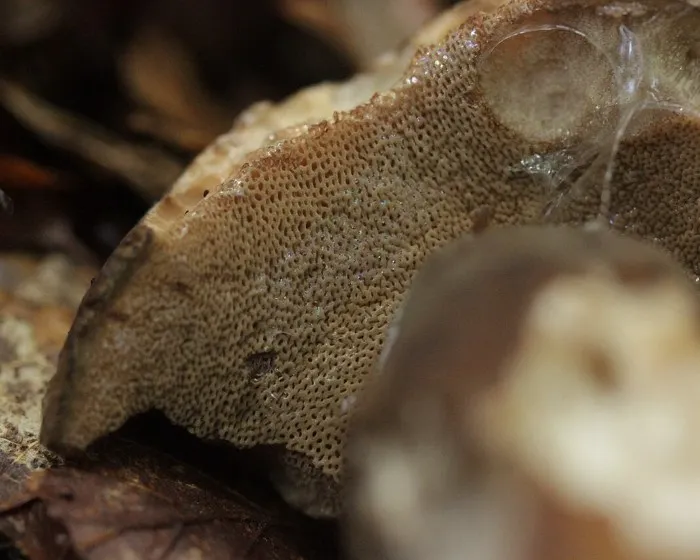
Tubes and pores: The tube layer is thick, adnate to the stem or curving slightly upward before it. Pores narrow, initially greyish-pink, later dark brown like the cap; bruising may cause blue-green and then blackish discolouration.
Stem: 5–12 cm tall and 1–3.5 cm thick, stout, cylindrical or ventricose, sometimes bulbously enlarged toward the base. Finely granular and cap-coloured on a whitish to brownish background; the stem base always remains paler and whitish.
Flesh: Firm, white to pale cream. When cut, it may become faintly pinkish or blue-green, then slowly blacken. Smell and taste are usually indistinct, sometimes sourish or unpleasant.
Spores: Spore print rusty brown with a reddish-brown tint. Spores 13–19 × 7–9 µm, ellipsoid, smooth and thick-walled.
Occurrence: A mycorrhizal species of acidic mountain soils in spruce, fir and other conifer woodland, more rarely broadleaf woodland. It occurs with spruce, fir, two-needle pines and beech from June to October.
Edibility: Treated as poisonous or unsuitable for consumption. Rare and protected in Hungary, with a conservation value of 10,000 HUF; it must not be collected.
Lookalikes: Usually recognisable by its uniformly dark cap, stem and darkening spore-bearing layer in age. It may resemble the bay bolete, but that species usually has a shinier cap and pores that blue more strongly when bruised.
Note: Porphyrellus combines Greek porphýra (“purple dye”) with the Latin diminutive -ellus, referring to dark reddish-brown to purplish shades. Porphyrosporus derives from Greek porphýra (“purple”) and sporá (“spore”), referring to the dark reddish-brown spore print.
Species description: Elias Magnus Fries and Johan Hök first described the species as Boletus porphyrosporus in 1835. Jean-Edouard Gilbert transferred it to Porphyrellus in 1931.
Taxonomy
- PhylumBasidiomycota
- ClassAgaricomycetes
- OrderBoletales
- FamilyBoletaceae
- GenusPorphyrellus
- Species: Porphyrellus porphyrosporus
- Authority: (Fr. & Hök) E.-J. Gilbert (1931)
- English name: Dusky bolete
- Ecological status: mycorrhizal
- Edibility: poisonous
