
 I have loved mushrooms since childhood, and I have also been a programmer for a long time. Combining these two hobbies, I wrote this website. Previously, I had two other mushroom identification sites, which I sold. Only one of them remains accessible today. My goal with the current site is to create an easy-to-use search and identification platform that works great both in the field and at home. I hope it brings joy to others.
Bartha László
Species flashcards
Practice area: created for the 303-species Hungarian mushroom inspector requirement. It is not an official examination; requirements in other countries may differ.

Tuberous polypore
Polyporus tuberaster
edible
Protected · 5 000 Ft
- Habitat: deciduous
- Fruiting season: May – October
- Cap: spreading funnel-shaped scaly hairy
- Stem: cylindrical tapering lateral felty scaly
- Fertile layer: decurrent porous angular wide
Description
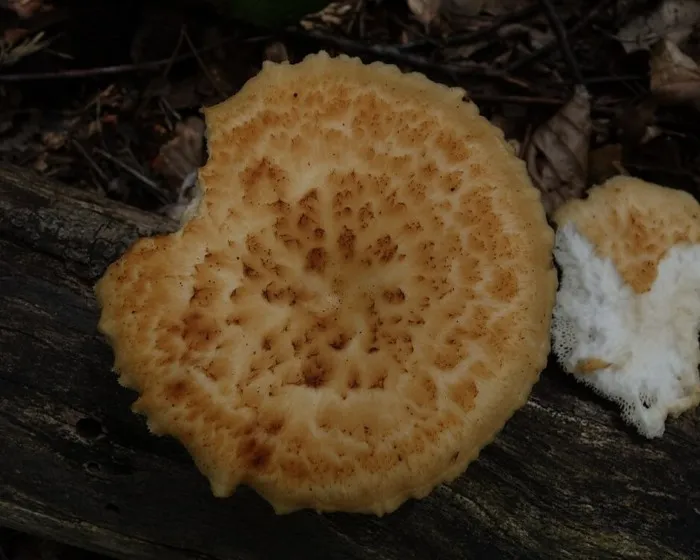
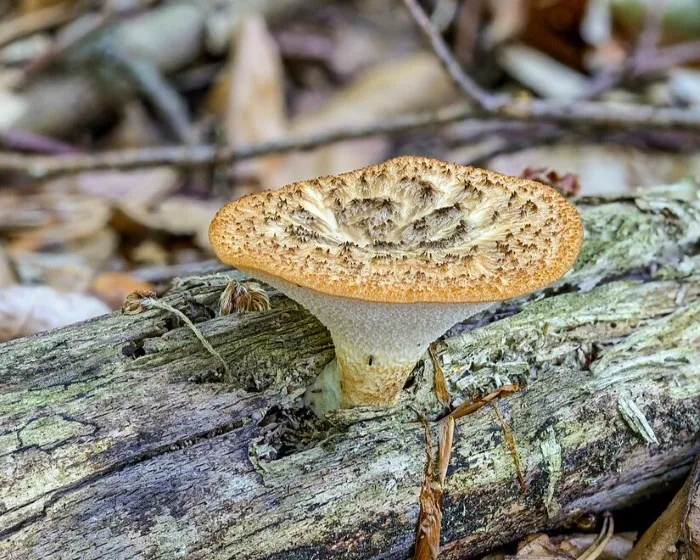
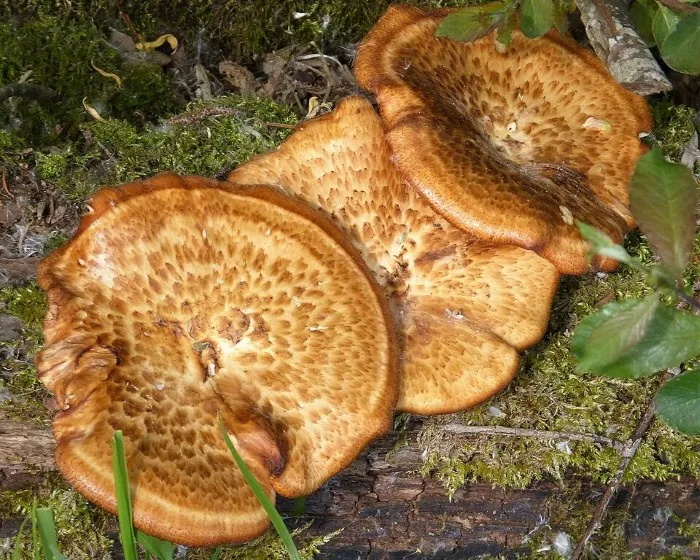
Fruiting body: The cap is 5–15 cm across, convex when young, later spreading and usually depressed or funnel-shaped at the centre. Its ground colour is whitish-yellow, ochre to orange-brown; the surface bears darker brown, concentrically arranged scales. The thin margin is often finely hairy.
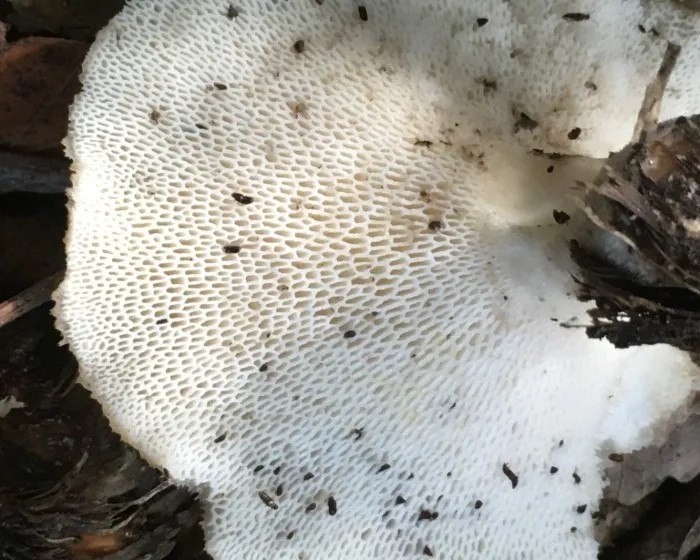
Spore-bearing layer: Porous, white to cream, later cream-ochre. The pores run slightly down the stem and are wide, rounded, elongated or irregularly angular, about 0.5–2 mm wide.
Stem: 3–8 cm tall and 0.5–1.5 cm thick, usually central, less often lateral, cylindrical and tapering towards the base. Whitish, ochre to rusty yellow, brownish at the base; surface felty and scaly.
Flesh: White, soft and brittle when young, becoming leathery and tough with age. Smell weakly mushroom-like, taste mild or slightly bitter; the bitterness usually disappears during cooking.
Spores: Spore print white. Spores 12–16 × 4–6 µm, cylindrical to narrowly ellipsoid, smooth and colourless.
Occurrence: A saprotrophic species on dead, often partly buried branches, trunks and roots of broadleaf trees. It occurs especially on beech, oak, hazel, alder and willow, from late spring to autumn.
Edibility: Edible, but pleasant in texture only when young; older fruiting bodies are tough. It is a protected species in Hungary and must not be collected.
Lookalikes: It may resemble the dryad’s saddle, which is usually larger, more coarsely scaled and has a darker to blackish stem base. The tuberous polypore is smaller, more finely scaled and may grow from a sclerotium.
Note: Polyporus means “many-pored”, referring to the numerous small pores of the spore-bearing surface. The epithet tuberaster means “tuber-like”, referring to the tuber-like sclerotium from which the fruiting body may develop.
Species description: Elias Magnus Fries published the current name in 1821, based on the work of Nikolaus Joseph von Jacquin and Christiaan Hendrik Persoon.
Taxonomy
- PhylumBasidiomycota
- ClassAgaricomycetes
- OrderPolyporales
- FamilyPolyporaceae
- GenusPolyporus
- Species: Polyporus tuberaster
- Authority: (Jacq. ex Pers.) Fr. (1821)
- English name: Tuberous polypore
- Ecological status: saprotrophic
- Edibility: edible
