
 I have loved mushrooms since childhood, and I have also been a programmer for a long time. Combining these two hobbies, I wrote this website. Previously, I had two other mushroom identification sites, which I sold. Only one of them remains accessible today. My goal with the current site is to create an easy-to-use search and identification platform that works great both in the field and at home. I hope it brings joy to others.
Bartha László
Species flashcards
Practice area: created for the 303-species Hungarian mushroom inspector requirement. It is not an official examination; requirements in other countries may differ.
Velvet shield
Pluteus umbrosus
edible
Protected · 5 000 Ft
- Habitat: deciduous forest
- Fruiting season: June – October
- Cap: convex flattening scaly
- Stem: cylindrical scaly
- Fertile layer: free dense standing
Description
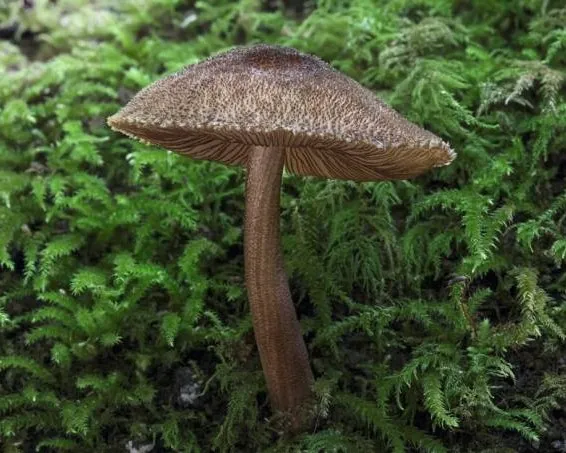
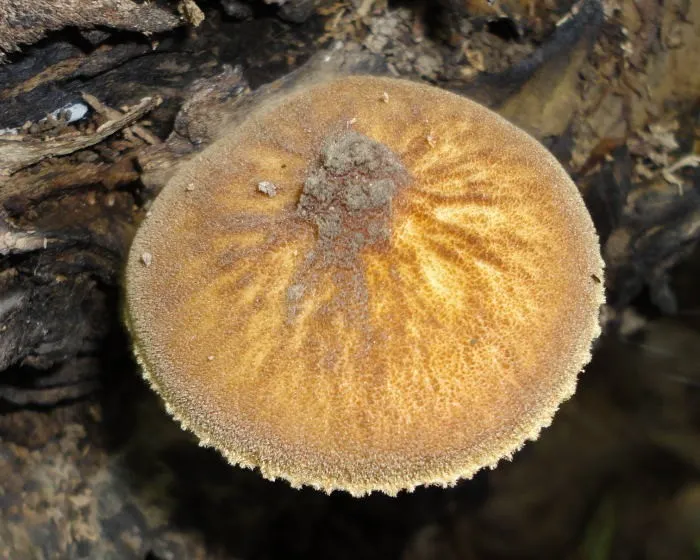
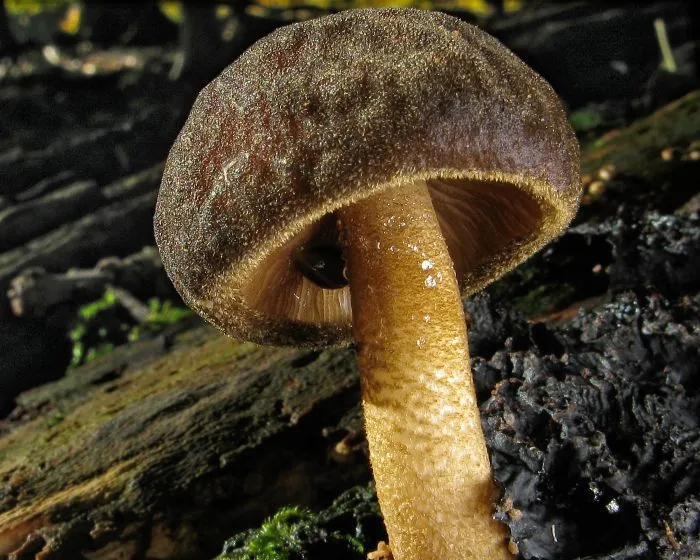
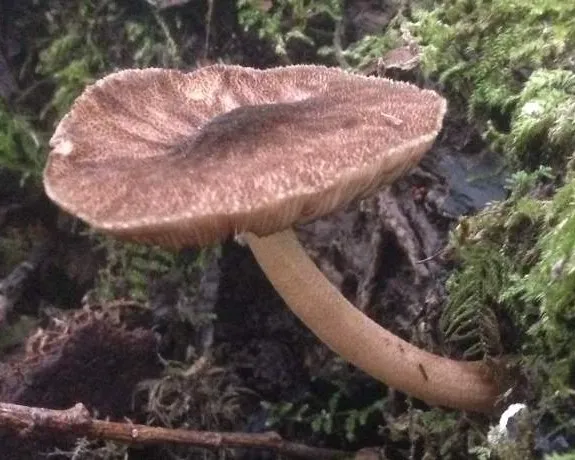
Cap: 4–10 cm across; convex when young, later flattening and often slightly umbonate. Dark brown, umber-brown to almost blackish, with velvety dark scales and radial wrinkles; the margin is often paler and floccose.
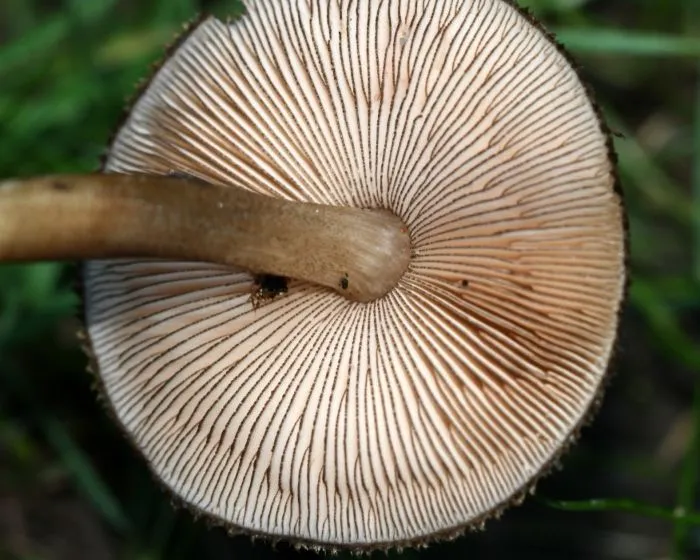
Gills: Free, crowded and ventricose. Whitish to pale pink when young, later flesh-pink; the edges are characteristically dark brown to blackish and floccose.
Stem: 3–8 cm tall and up to 1 cm thick, cylindrical and slightly thickening towards the base. Whitish, especially in the lower part covered with brown-black flocci or fibrous scales.
Flesh: White, thin and soft in the cap, tougher in the stem. The smell may be slightly musty or radish-like; taste unremarkable.
Spores: Spore print pink; spores broadly ellipsoid to nearly spherical, smooth, 6–7 × 4–5 µm.
Occurrence: A saprotrophic species fruiting from summer to autumn, singly or in small groups, on large decaying stumps and logs of broadleaf trees, often with other Pluteus species.
Edibility: Inedible. The species is protected in Hungary, where collecting it is prohibited.
Lookalikes: Similar to the fleecy shield and other dark-capped Pluteus species. Its dark-floccose gill edge, velvety-scaly cap and dark-scaly stem are distinctive.
Note: The Latin pluteus originally denoted a movable protective structure or wooden screen used in ancient warfare. In fungi, it refers to the cap arching above the stem like a shield or roof. Umbrosus derives from umbra, shade, referring to the dark brown to nearly black cap and dark gill edges.
Species description: First described by Christiaan Hendrik Persoon and transferred to Pluteus by Paul Kummer in 1871.
Taxonomy
- PhylumBasidiomycota
- ClassAgaricomycetes
- OrderAgaricales
- FamilyPluteaceae
- GenusPluteus
- Species: Pluteus umbrosus
- Synonym: Agaricus umbrosus
- Authority: Christiaan Hendrik Persoon and Paul Kummer (1871)
- English name: Velvet shield
- Ecological status: saprotrophic
- Edibility: inedible
- Protection status: protected in Hungary
