
 I have loved mushrooms since childhood, and I have also been a programmer for a long time. Combining these two hobbies, I wrote this website. Previously, I had two other mushroom identification sites, which I sold. Only one of them remains accessible today. My goal with the current site is to create an easy-to-use search and identification platform that works great both in the field and at home. I hope it brings joy to others.
Bartha László
Species flashcards
Practice area: created for the 303-species Hungarian mushroom inspector requirement. It is not an official examination; requirements in other countries may differ.
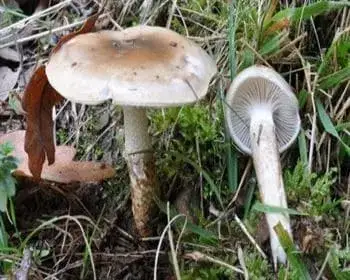
Persoon's Woodwax
Hygrophorus persoonii
edible
- Habitat: deciduous
- Fruiting season: September – November
- Cap: convex umbonate smooth infolded
- Stem: cylindrical tapering
- Fertile layer: adnate decurrent sparse smooth
Description
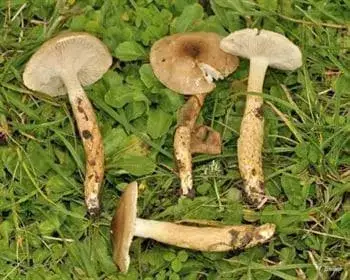
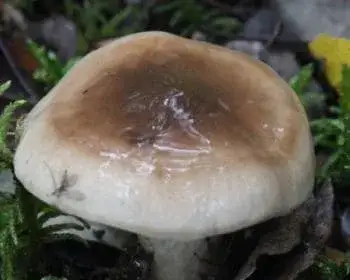
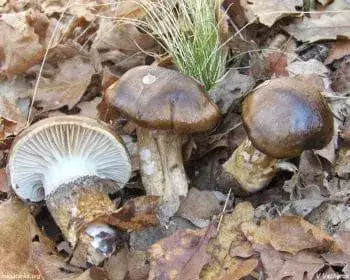
Cap: 5-8 cm in diameter; convex when young, its margin infolded for a long time, umbonate in the center, then spreading, its umbo remaining; dirty brown, olive-brown, grayish-brown, its center often darker; strongly slimy surface.
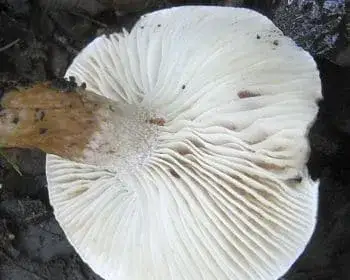
Gills: Decurrent on the stem, distant, thick; white.
Stem: 5-12 cm long, 1.2-2 cm thick; cylindrical, tapering towards the base; white at the apex, powdery, powdery, brownish marbled on a white base below the ring zone, slimy; when young, a slimy cobweb-like veil connects the cap margin to the stem, which disappears without a trace over time.
Flesh: Solid, white; no particular smell and taste.
Spore: White; 10-12 × 6-7.5 μm; egg-shaped.
Occurrence: From September to November; in deciduous forests, quite common species.
Edibility: Edible.
Confusion: Similar to the equally edible, lighter-capped and stemmed; related species the olive-brown woodwax. Cannot be confused with any other species.
Note: hygrophorus means from hygro - water, moisture, and phorus - bearer.
Species description: The name Hygrophorus dichrous is attributed to Kühner & Romagn from 1953. The first scientific record dates from 1774, as Agaricus limacinus, attributed to Schaeffer. In 1979, the name Hygrophorus persoonii was also registered.
Taxonomy
- PhylumBasidiomycota
- ClassAgaricomycetes
- OrderAgaricales
- FamilyHygrophoraceae
- GenusHygrophorus
- Species: persoonii
- Described by: Arnolds (1979)
- Hungarian name: olajszínű csigagomba
- Lifestyle: mycorrhizal
- Edibility: edible
